
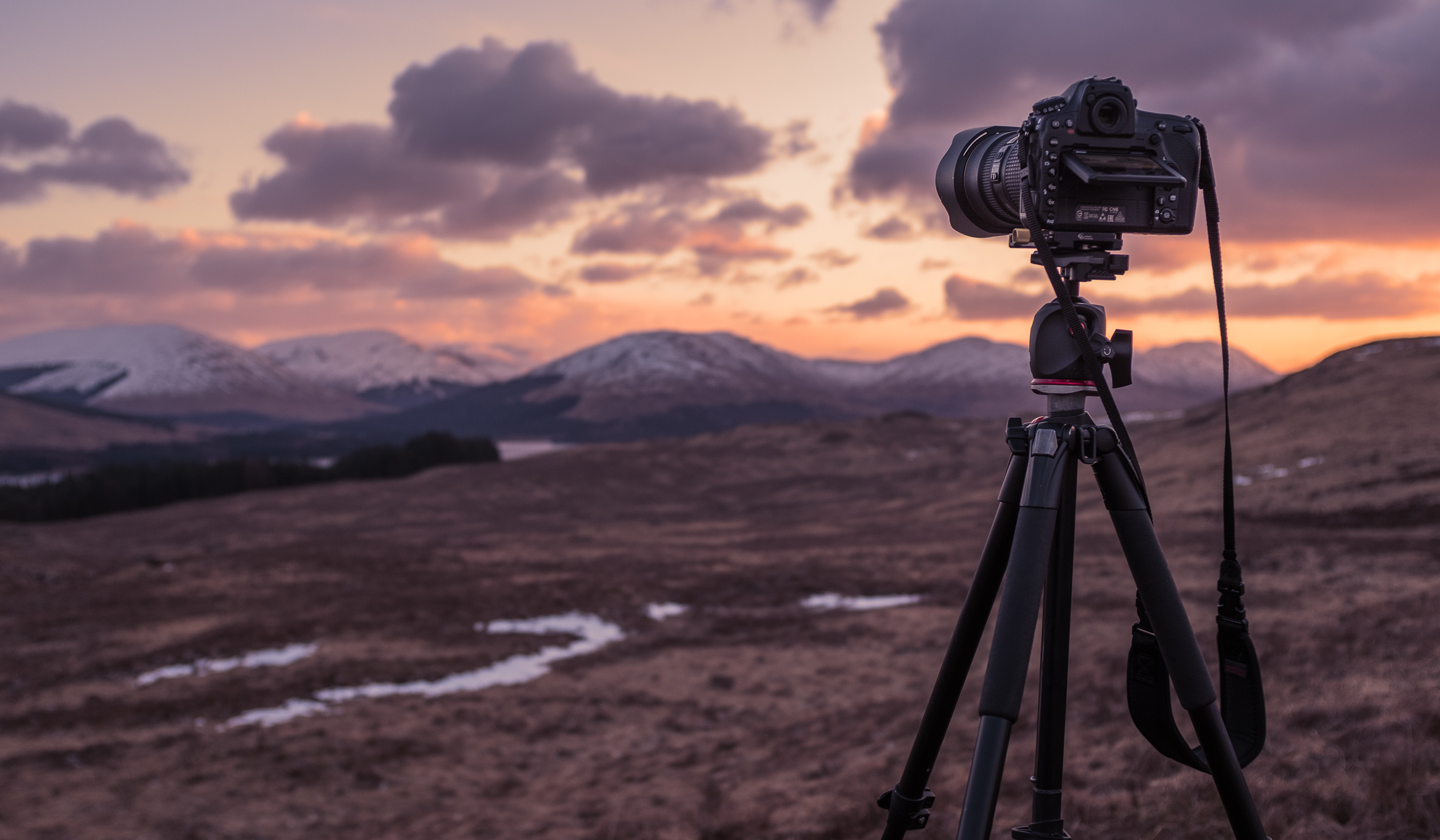
A beautiful Scottish Highland sunset.
The days begin early. The alarm sounds around 3:30AM to make the hike to the sunrise location. Depending on the time of year, and the location, I may be waking from only a few hours sleep. In southern Alberta, for example, the sun doesn’t set until around 10:00PM in June. Sleep is scarce if you plan to be present for the beginning as well as the end of each day.
If I decide to sleep in, just once, the fiery sunrise that I may have missed will haunt my thoughts. The locations never change. The mountains don’t move, the trees grow unknowingly slow, and the rivers always flow the same direction. The light, however, will always change. Bare blue skies will give you an infinite amount of negative space to compose a shot. Puffy clouds will allow the sun to peak in and out and dot the landscape. Storms, probably more so than any other weather event, have a dramatic effect on the landscape I’m photographing, and it’s that kind of weather that will typically produce the most compelling images. Keeping an eye on the forecast and on the ever changing light is absolutely necessary.

Waiting on sunset at Badwater Basin in Death Valley National Park amidst a looming cloudy sky.
I arrive before daylight to the location that I marked on GPS the day before. Scouting a location ahead of time for sunrise is useless if you can’t get back to it in pre-dawn darkness. To make navigating a little easier, I sometimes mark the entry point with a rock cairn. GPS is only accurate to around 30 feet and these rock totems make finding the way back to a very specific spot in the dark a little easier. Climbing a boulder outcropping to a specific piece of vegetation or rock formation you’ve found previously is much easier if you plan the route ahead and mark it adequately. Being 30 feet away from your mark in a dense rock formation before daylight will leave you waiting on first light, scrambling to find your intended target. By the time you’re able to set up gear and compose your image, it may be too late. So, preparation is key.
The first sun rays of the day have an incredible effect on all the elements in your vision. If you’re on the water, the reflection of the warm sky will glisten back at you. If you’re in the desert, the dunes and mesas will become incredibly colorful and jump to life with depth, and if you’re in the mountains, the first bit of alpenglow on the mountaintops will make you want to never leave. It’s a truly a magical time that only lasts seconds. Once I’ve made a few different compositions, I move on to another location. By now, the sun is still low in the sky, but rising fast, so it’s important to move quickly as the shadows will soon be filled with light, and the depth will be gone.

After a few hours, I usually take a break for a bite to eat and plan the rest of the day.
Exploring the area, I’m looking for daytime compositions that include texture and patterns and do not necessarily require compelling light to make an image. As I explore, I’m watching for a composition for sunset that evening and sunrise the next morning. This daily exploration can happen on foot over the course of 5-10 miles, or over hundreds of miles with a vehicle. I’m always aware of the future direction of the sun, as it’s path will dictate how I’ll photograph a particular scene. The clock is still ticking as I break for lunch. While often the vast majority of captivating landscapes are taken at sunrise and sunset with the incredible and rarely seen light, there are certainly images that can be made in the middle of the day, but finding great compositions becomes more important when you don’t have beautiful light to rely on. Once I’ve found my sunset location for the evening, I mark it on the map, then move on to scouting a spot for the next morning.

Two Medicine Lake, Montana
The last few minutes of the day will often yield incredible images, but it may be worth staying around longer to capture a few night images with the stars. The stars in unpopulated locations glow like lanterns floating in the sky, and the moonlight can show you a shadow as sharp as the midday sun.

Exploring desert lava tubes.
I don’t typically have a chance to eat dinner before sunset, and will have to eat afterward. In June, in Alberta, that means after 10:00PM. A very quick bite to eat and it’s time to catch some rest, as I’ll be up again in a few hours to repeat the entire process.
It’s hard work, and I can’t imagine many people would want to stick around for more than a day. There’s no fancy dinners, there’s no luxury hotel rooms, shopping, or sightseeing – but the views are unbelievable. The game is in the gamble. No two images, even of the same location, will ever be the same. The weather and light are forever changing, and will leave you with different results every time. Sometimes you go home with several great images, sometimes you go home with nothing. With proper planning, you can improve your odds by reading the weather, light, elevation plots, and atmospheric conditions, but still, you do not always leave with an image.
It isn’t a vacation, it’s not a getaway – my only purpose is to make photographs.

Waiting out a snowstorm in Scotland.